

Summary: I have a hypothesis that dependent behavior has similar features between people in a couple and between societies in the world. In this article, we will consider the main aspects of a large and voluminous topic, namely: dependence, codependency, addiction, healthy symbiosis, their similarities, and how they differ from each other. My goal is to show how these processes are influenced by separation, autonomy, spontaneity, the ability to take responsibility, and what role the Karpman triangle plays in this. In this article, we will also consider chemical dependence, for which there is a separate term – addiction, and codependency is very clearly manifested in it. Using the example of Ukraine, we will analyze the triggers that, in my opinion, include some people in the process of supporting accession to the russian federation. We will consider autonomy by using the example of Norway and its indigenous Sami people, most of whom live in northern Norway. The Sami people underwent a painful and traumatic separation from Norway and gained the right to autonomy, their language, their traditions and culture only in 1992, although they have lived in this territory for about 2000 years, so they are officially recognized as an indigenous people with their own identity. We will also consider the impact of trauma through bullying on dependence and codependency, both from a partner, or school, or parents, and at the level of societies.
Keywords: dependence, codependency, addiction, Integrating Adult, Karpman's triangle, trauma, bullying, healthy symbiosis, attachment, separation, spontaneity and autonomy.
This topic is large, but I will highlight the main points that will help to see with examples how they work and how they manifest themselves in relationships. To do this, let's first turn to the definitions of concepts. Let's start with the term dependency. The most important thing for us is to determine the criteria that are needed for its diagnosis. They are clearly spelled out in the DSM-5.
In general, a dependent person or society has a high propensity for rescue, unnecessary, unwanted care, leading to controlling or submissive and clinging behavior, as well as a fear of separation, starting in early adulthood (for the person, as well as, for example, a young independent state) and the presence of at least five (or more) of the following criteria:
It is difficult to make everyday decisions without an excessive amount of advice and reassurance from others. For example, a woman who cannot choose a dress for herself, or a hobby, or a place of work without the advice of her husband. A woman who gives up herself, her desires, in order to live, like a parasite, someone else's life, to be a victim and not take responsibility for her own life. Eric Berne called this the game "If it weren't for you...". At the level of society, a vivid example is belarus.
The need for others to take responsibility for most of the major areas of his or her life. For example, a woman who has the Parent Contamination “The man has to pay for everything.” If you ask such a woman, “What about you?”, the answer is often strikingly infantile, “And I have to be nice.” At the state level, this is the myth of big brother.
Has difficulty with expressing disagreement with others due to fear of losing support or approval. (Note: does not include realistic fears of payoff.)
Has difficulty with initiating projects or doing things on his own (due to a lack of confidence in his judgment or abilities, not a lack of motivation or energy).
Putting in excessive effort to receive care and support from others is, in essence, voluntarily doing things that are unpleasant.
The person feels uncomfortable or helpless when alone, due to an exaggerated fear of being unable to take care of themselves.
In close relationships, the search for other relationships as a source of care and support ends.
Unrealistic preoccupation with the fear of being left alone to care for oneself. (Diagnostic criteria from DSM-5, p.675, English version)
At the state level, we have a vivid example of dependence –the russian federation and belarus. An example in a relationship is a woman who is completely dependent on an authoritarian man.
Dependence from the perspective of transactional analysis looks like this: (Tony White's article "Symbiosis and Attachment Hunger", p. 2.)
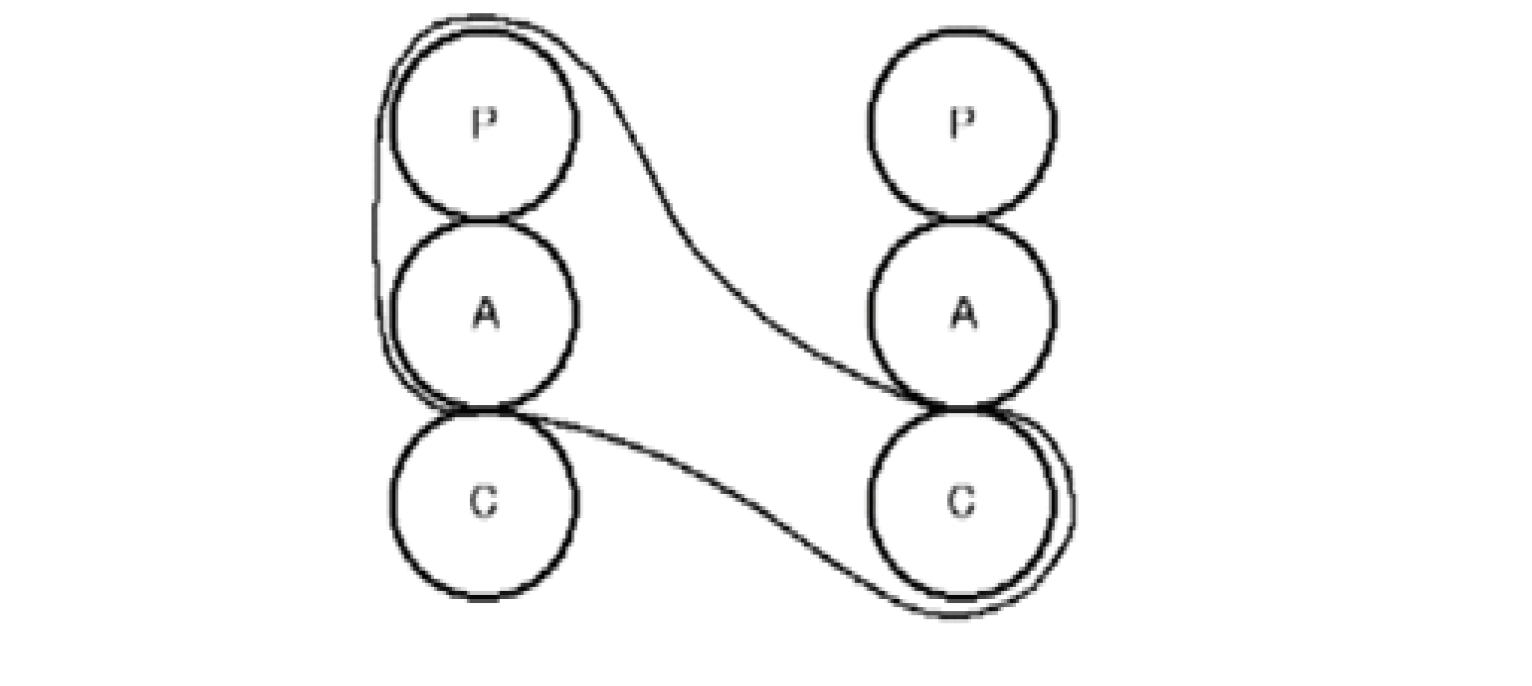
In this picture, P is from the English word parents. In his book “Working with drugs and alcohol users. A guide to Providing Understanding, Assessment and Support” (p. 93), Tony White emphasizes that in the symbiosis of addiction, different variations are possible, but in this pair, one person will always have the Parent and Adult Ego-states excluded, and their partner, on the contrary, has the Child Ego-state excluded. In place of the Parent Ego-state, there can be parents, drugs, alcohol, a wife or husband, sex, gambling, religion.
In transactional analysis, dependency is called symbiosis. There is a healthy and unhealthy symbiosis. Healthy symbiosis is when the mother carries, supports, feeds and clothes the child after birth. It is based on healthy attachment. The mother’s Child Ego-state should be included in the Child’s Child Ego-state. That is, the mother reacts to the child’s emotions, while containing and enduring them and teaching the child to name these emotions, normalizing their state. (Tony White. “Symbiosis and Attachment Hunger”, p. 4).
Or there is a functional symbiosis. It is also healthy. In a couple, it manifests itself when help and care are needed, for example, when a woman after surgery and physically cannot do much on her own, and the man performs her functions with love, responsibility and respect. At the level of countries, this is assistance to Ukraine during the war with weapons, equipment, intelligence, etc.
Unhealthy symbiosis, as Tony White notes in his article, is based on unhealthy attachment. He notes that there can be overattachment, which leads to excessive attachment to another person. In individuals, this is most clearly manifested in dependent personality disorders. (Tony White. “Symbiosis and Attachment Hunger”, p. 4).
In other cases, the author notes, attachment can be hostile-dependent. In such an attachment there are threats of abandonment/renunciation, and attachments that are sadistic, punitive, etc. At the level of societies – we see this again in the example of belarus and the russian federation, and the russian federation’s attitude towards Ukraine. (Tony White. “Symbiosis and Attachment Hunger”, p. 4).
Such people or societies avoid healthy attachments. That is, in healthy attachment, people do not stick to each other, they like the closeness that directly provides attachment. For example, in my opinion, these are the countries of the European Union or the Scandinavian countries, which understand that they are interdependent, and at the same time independent. (Tony White. “Symbiosis and Attachment Hunger”, p. 4).
Let's also consider codependency and dependence, and what role does the Karpman’s triangle play. So, dependence or addictions are disorders that are associated with the use of alcohol and psychoactive substances (SUD). This also includes other addictions, such as gambling, shopaholics, workaholism, sexual addictions, anorexia, bulimia, kleptomania, etc. They have a similar principle of operation. Addiction is considered a protective function against traumatic experiences and dysphoria, which is why it is so difficult to get rid of. (Manual of Psychodiagnostic Diagnosis, Vittorio Minnjiari, Nancy Mc Williams, p.297).
The addiction formula is simple: Addiction = pain + use + temporary short-term relief + even greater and longer pain.
This cycle repeats itself with increasing alcohol or drug use or other addiction.
Karpman's triangle plays a central role in the formation of addiction. For example, a couple where a woman dependent on an authoritarian man (who was previously raised by an authoritarian father) has a son. Suppose the son goes to elementary school and one day gets a bad grade. He comes and tells his mother about it because he is afraid of punishment from the cruel father. The mother, instead of explaining to her son that he needs to take responsibility and simply study the material and correct the bad grade, shields her son from her father. In fact, she unconsciously protects herself, the little girl, from her aggressor father. When the father does find out, he attacks the mother who saves the son, then the mother becomes the Victim, the son Rescues the mother, and switches and son Persecute the father, then, for example, the father gives up and switches to the position of the Victim. This is where addiction is born, it appears long before the first use. Because no one in this triangle knows what responsibility is. The adult Ego-state is not formed in such a child. The brain understands that there are easier ways to solve problems.
It is this Rescue, first from the mother, and then from the wife, that becomes the key to abuse. This is not the influence of bad companies, but rather the unresolved separation from the mother and the inability to take responsibility. Or the same effect can be due to permissiveness. For example, when a mother raises her son alone without a father, and allows him everything. He does not know the words “no, you can’t”. He wants a toy, or sweets, and the mother buys him everything on demand, especially when he is hysterical. Then the child has no boundaries, the rules are not respected, the brain understands that pleasure must be satisfied immediately. That is, addiction is often a chemical addiction. And codependency is a person’s dependence on an addicted person. That is, a person who uses alcohol and/or SUD. When an addicted person, by all means, is looking for another use again, the codependent person is looking for and saving, or trying to control, the addicted person with the same force.
First of all, you need to treat the codependent partner, because the chemical addiction will pass in a year or two if endure it and do not use. According to Claude Steiner, the treatment of alcoholism (this is also true for substance abuse), the only thing that can help is a counter-scenario, namely “Stop drinking.” (Claude Steiner, “Scripts People Live,” p. 123). But if the codependent partner or the mother, or parents, or grandmother, who often replaces absent parents, did not undergo psychotherapy, then there is a 99% probability that the person with the addiction will return to abuse. The codependent person will begin to cause good, and the addict one will begin to cause pleasure for himself.
Another nuance in working with an addicted person is to change their thinking and behavior. As we remember, this person’s brain has learned to satisfy its needs in easier ways, the person has a very large Child Ego-state, with developed pride, egocentrism, and irresponsibility. It is impossible to change behavior and thinking only with the help of a counter-script. (Stephen Karpman, “A Game Free Life,” pp. 188-192) A person can break down at any trigger from the past. In addition, it must be remembered that very often such adults have had many traumas both at home and at school. Very often they were exposed to bullying from both teachers and classmates, to physical and psychological violence. (Starkov D.Yu., Yary V.V., Olishevsky O.V. “Organization of inpatient medical and psychological rehabilitation of disorders associated with mental trauma and stress, 2023, p.9-10). That is, traumatic events must be worked through, and with the help of psychotherapy, it is necessary to work on getting out of the Karpman triangle, increasing the Adult Ego-state, deconfusing the Child Ego-state and integrating the traumatic event into one’s life line, integrating the splitting of the Child Ego-state and traumatic experience. This is how an integrating Adult is formed.
At the level of society, we see this in Ukraine, where there is a split, when one part of the population supports russian world. They act on the principle of codependent personality. First, their brain remembers that it is easier that way, and avoids responsibility. Second, several generations have unprocessed traumatic events of bullying of an entire people, its language and culture. That is, there is still a traumatic split there.
Let's consider how this works out at the level of society, with the example of the Sami. When Norway gained independence, a lot of people were nationalists. If we take the history of Norway, it was under Denmark for 350 years. After the Napoleonic Wars in 1814, Denmark was forced to give Norway to Sweden, after Napoleon lost the war, and Denmark was an ally of France. That is, at the time of independence, due to the fact that Norway had been under Denmark for many centuries, it completely lost its written language. Due to the fact that Norway is one of the longest countries in terms of territory, it has many dialects. Therefore, the Norwegian language, both written and spoken, was created anew from dialects relatively recently. That is why, when Norway became independent, the Norwegianization of the indigenous peoples, primarily the Sami, took place. Children were forcibly taken from their homes and taken to boarding schools. Children were forbidden to speak the Sami language or wear national clothes at school. Norwegian children and teachers often severely abused Sami students. In addition, legislation supported Norwegianization at all levels. A law from 1902 stated that only Norwegian citizens who could speak, read, and write Norwegian could buy land. This law remained in effect until 1965. (Sami, URL: https://samfunnskunnskap.no/ru/eto-norvegiya/saamy.html#del2, date of appeal: 07.04.2025). The reality was this: in order to survive, many Sami people forgot their language and culture. But the healing of this people began from the moment when the Norwegian government admitted its mistake publicly and made an official apology to the entire Sami people. It was when the Sami language was recognized as the second official language in Norway. It was when Sami schools appeared, and the Sami Parliament, which has a voice in resolving issues related to the territory where the majority of the Sami live and issues related to the Sami people. As compensation, the Sami were given many benefits. But for this, a person must prove that he has Sami roots. This is either speaking the Sami language and living in the Sami territory, or you must prove that your grandmother or grandfather was Sami. Remember that Norwegianization took about 150 years, and this is several generations. Therefore, many Sami do not speak their own language. Secondly, it was necessary to prove your residence in this territory. Many Sami, in order to survive, began to hide their own origin even from their children. Let's remember the law on the right to own land. That is, now it is very difficult to prove that you have Sami roots.
If we consider the history of Ukraine and its very long dependence on russia and the soviet union, if we take into account the russification and humiliation of the Ukrainian language and culture, if we take into account the fact of mass repressions and the resettlement of entire villages and cities to the north of russia in very difficult living conditions and poverty, if we take into account the failure to recognize one’s mistakes, the refusal to accept responsibility, the desire to do good, to save russian-speaking Ukrainians, and the traumatic experience of the Ukrainians themselves, who survived the camps and many murdered cultural figures, then it becomes clear that this is a hostile-sadistic attachment in which a part of the population of Ukraine is co-dependent with the russian federation. And the russian federation is dependent.
The dependence of the russian federation is manifested in the conquest of other states. And this is no longer a personality disorder, but rather a psychiatric disorder, because one of the syndromes of the psychotic level is delusional super-valued ideas, delusional ideas of grandeur, one of which is the restoration of the "great russian empire."
The codependency of a part of the pro-russian population is a childish, infantile, and irresponsible position. Therefore, both the codependent and the addicted need to be treated.
If it is important for an addict to reach their bottom, that is, complete loss – both a complete economic crisis and physical collapse – it is necessary to endure a period of abstinence in isolation with the help of a counter-scenario and only later psychotherapy. And therefore, one of the medicines for a co-dependent population will be the fight against corruption at all levels, compliance with rights and laws with dignity and respect for human rights and one's duties.
Ukraine, like Norway, has dreamed of its independence for many centuries. Norway has lost its language over these centuries, but it has not lost its desire to become independent. Due to the fact that Norway is a relatively young society, it made many mistakes when Norwegianizing the indigenous peoples of the north. But having matured, it was able to take responsibility, admit and correct its mistakes. Although many Sami have forgotten their language, they have not forgotten their roots, and most have fought to revive their identity.
Norway, as a nation, has united to gain its independence. The Sami, as a people, have united to fight for their right to a national identity. But the Sami have a relatively small population, they will not survive without economic support, so autonomy with the main government in Oslo, Norway, is enough for the Sami.
As for Ukraine, with its large population, its resources, and also its very large territory, Ukraine cannot be autonomous as part of another state, as, for example, Crimea used to be. It should only be an independent sovereign state.
One of the reasons why Ukraine has codependent tendencies is internal division, it is a trauma of an entire people, it is territorial division. Neither the Norwegians nor the Sami were forcibly resettled by the government to another country, for example, to Denmark or Sweden. Therefore, the roots and love for their nationality have been preserved through generations among both the Norwegians and the Sami.
The violent uprooting and relocation of part of the people from one territory to another also created a transgenerational scenario with the passing of a hot potato from generation to generation (Fanita English, "Self-Realization Throughout Life," pp. 158, 189).
The very fact of the state accepting its mistake and taking responsibility for its actions at the highest level, recognizing the facts in history, which we see in the example of Norway, creates space for the assimilation of the traumatic experience of the people, recovery from dependent relationships, the Adult position and responsibility of each individual in society, separation and recognition of their independence.
To start treating an addict, he must reach the very bottom and want to be cured himself. The problem is not only in chemical intoxication and organic changes in the body, the most important problem in treatment is to change thinking and behavior. To do this, a person must realize that, firstly, he is sick, and secondly, he needs help, he must realize what triggers him, accept responsibility for his own actions, and make a decision about full recovery. But if a person or a state committed a crime, even if he was in a twilight state, he must be tried for crimes and treated during punishment. This person must also be isolated from society, and the state must be isolated from other countries for this time. The key to successful treatment of addiction, codependency, and dependence is accepting responsibility and raising an Adult. This can only be achieved if you get out of Karpman's triangle. This applies to both a person and society.
Literature
-
Diagnostic and Statistical Manual of mental disorders, 5+th edition, DSM-5, American Psychiatric Association, Washington, New School Library, DC London, England.
-
White, T. (1997). Symbiosis and Attachment Hunger. Transactional Analysis Journal, 27 (4), p. 300–304.
-
White, T. (2012). Working with drug and alcohol users. A guide to Providing Understanding, Assessment and Support. Jessica Kingsley Publishers, London and Philadelphia.
-
McWilliams, N. (2025). Psychoanalytic Diagnosis. Understanding Personality Structure in the Clinical Process. Kyiv: Rostyslav Burlaka Publishing House.
-
Steiner, K. (2021). Scripts People Live. Kharkiv.
-
Karpman, S. (2016). A Game Free Life. Kharkiv.
-
Sami. URL: https://samfunnskunnskap.no/ru/eto-norvegiya/saamy.html#del2 (accessed April 7, 2025).
-
Starkov D.Yu., Yary V.V., Olishevsky O.V. (2023). Organization of inpatient medical and psychological rehabilitation of disorders associated with mental trauma and stress: scientific and methodological manual. Kyiv.
-
English F. (2020). Self-realization throughout life. Kyiv.